 BrutalGamer Bringing you Brutally Honest feedback from today's entertainment industry.

Some lesser known brawling classics make the leap from the original PlayStation to the current gen. Knuckle up with Fighting Force Collection.
The Fighting Force returns
Talk about the beat ’em up genre for any length of time, and you’ll likely hear a few names come up. Most of those will probably hail from the arcades and 16bit eras, when the genre really had its heyday. Sure there are some great examples of the style even today, but those years were the sweet spot.
As that era rolled on however, styles changed and, more or less, the genre fell out of favor. The true side-scrolling beat ’em up vanished almost completely, though in its place was a new generation of 3D brawlers. These games were fewer and further between, though offered players fresh tilts on play.
Three-dimensional worlds were the highlights, as players could move their characters around a field that offered additional depth, but that wasn’t all. The fundamental look of the games changed as well. Polygons we ‘in’, and that brought visuals that now feel, for good or ill, very specifically set in that era.
Fighting Force and its sequel are decent examples of what I was just talking about. The initial installment of that series released for that original PlayStation and the N64, hailing from Core Design and publisher Eidos. A sequel would follow along two years later, debuting for the Dreamcast and again for the PS1.
That was 1999 though, and nothing has been seen or heard about the brand since. That’s one of the reasons I was so surprised to see Limited Run Games and Implicit Conversations bring Fighting Force Collection to life. This new bundling of the two titles serves up a double dose of nostalgia, complete with a few key extras.
A tale of two different games (and more)
Most beat ’em ups don’t have the greatest stories, and that’s true with both Fighting Force games. Mostly anyway, as the second installment goes a little heavier on narrative, along with a fairly stark contrasting to the original game. That’s right, these are two radically different titles, and you’d be forgiven if you thought they were unrelated at first glance.
I remember playing Fighting Force back in 1997, but I’m pretty sure I never played FF2. So this was the first time I actually dove in, and the difference between the two was a shock. We’ll get into that in a second, but if you’ve played both, then you likely have a favorite.
Beyond what I just talked about though, Fighting Force Collection sports multiple options during gameplay. And yes, all of those you’ll probably be used to if you’re into modern retro-gaming.
Extras, extras
Fighting Force Collection lets players adjust the looks of its games, to a solid degree. Amongst a more current visage, options exist to retro-ify both Fighting Force and Fighting Force 2. That’s not anything too above and beyond for these kinds of retro bundlings, but the CRT filter and screen-warping was particularly cool here. The simulation of a classic television works well, and makes things all that much more authentic.
Along with that, there’s a save and load feature too. Both games offer that already, being from the age of the memory card, but what’s nice here is that you can do it at any time. The original method was a little more limited (though you can actually still use it if you prefer!).
On top of that, there’s also the ubiquitous (and at times welcome) rewind feature. If you’re unsure of what that is, it’s a means to actually rewind gameplay if you mess something up. I try not to use it all that often, though it can be tough to resist. Catch enough cheap shots and you’ll see what I mean.
Finally, what’s a retro collection without a gallery of behind the scenes stuff? What’s included is not voluminous by any means, but you will find some images and sketch illustrations from both games. I’m kind of a sucker for that kind of stuff, so you better believe I dove in. I just wish there was more of it.
And on to the games
We’ve looked at what extras and options are included in this Limited Run Games offering, and now it’s time to get on to the good stuff. Of course, those are the games themselves. And as I hinted at above, they couldn’t be more different.
So, far and away, my favorite of the two is the original Fighting Force. As you’ll see in the mini-reviews below, the original title in the set has a fast-paced nature to it, is loaded with some great action, and stocks a highly re-playable vibe. It feels like an arcade game, and I mean that in a very, very good way.
Fighting Force 2 on the other hand, is a larger and deeper game. It also trades its gameplay out for a more methodical play style, which isn’t a bad thing, but does change the tone.
In any event, let’s dig in.
Fighting Force
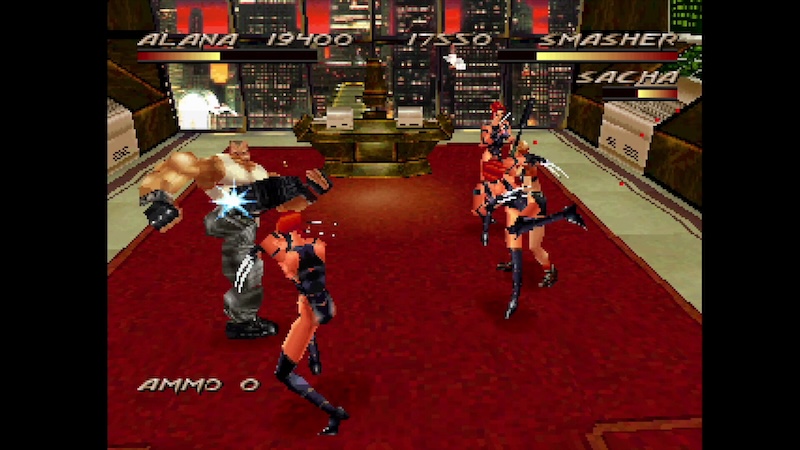
For those who’ve never played, Fighting Force is a fairly perfect encapsulation of the genre and the time period. Taking control of Hawk Mason or one of his three battlin’ pals, players fight their way through NYC in seven levels and 22 stages. But those levels are only partially linear. In a really cool touch, some have branching paths.
Via those, Hawk and crew can head to different parts of the city, as they seek to knock over the head of an evil organization. That’s something that can freshen play up nicely, lengthening the life of what’s an otherwise short experience. It’s also something of a rarity in a classic brawler, so it’s particularly cool to see in this 1997 classic. Actually, now that I think about it, it’s kind of rare in the games of today too, but I digress.
Classic controls
Co-op play is available in Fighting Force, and on higher difficulties I’d recommend making use of it. While the game is a breeze on easy, it ramps up significantly if you crank it up. Another big recommend would be to make use of the tons of weapons that are strewn about. Hawk (or whoever) can grab everything from pipes to guns, and I eagerly did just that.
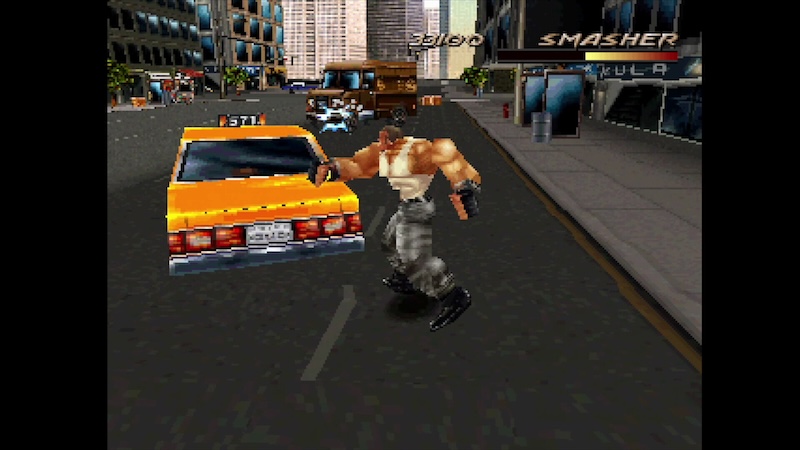
Speaking of the combat, it’s great fun, and the controls are spot-on. I loved waylaying hordes of foes as Smasher, the big brute of the group. Kicks, punches, and both rolling and diving attacks are all available, and tons of fun to pull off. That said, fists and feet can only take you so far.
There’s that selection of weapons I mentioned, to that end. They take the action well beyond the base means of attack, and spice things up nicely. Aiming with pistols can be a little hit and miss (no pun intended) but the melee weapons are on point. It’s particularly enjoyable to lay into a stream of foes, cracking them down one by one with a baton.
The looks of a (90s) champion
As for the game’s looks, well, this is the 90s in full effect. As mentioned above, the original game is a polygon paradise. I realize too, that might be jarring for some. It kind of was for me honestly, and I knew full well what I was getting into.
I got re-accustomed to the visuals fast however, and I dig ’em once again at this point. There’s just something about that mid-90s look, sharp and polygonal, that… works. The visuals of games like Streets of Rage and Final Fight typically get all the love, but there’s a real level of stylistic fun that games like Fighting Force just bullseye.
It’s more than the nostalgia fueling my opinion, because Fighting Force offers something that’s visually night-and-day different to the whole of the current beat ’em up field. I’d like to see more games that play on that 90s aesthetic.
Fighting Force 2
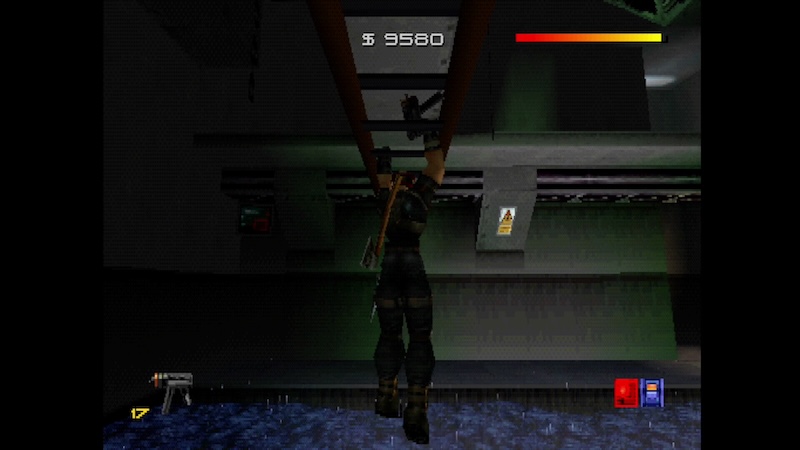
And now for something completely different. No, really, completely. The main man, Hawk carries over into Fighting Force 2, but this time he’s a mercenary super-agent. He’s ditched his street gear, and is decked out in combat armor. Not only that, but the game has a wholly new setup, and completely eschews the multiplayer dynamic. And that’s not all that’s different.
Combat is still in the spotlight for Fighting Force 2 obviously, but it’s handled completely differently. Instead of being a frenetic brawl in the streets, this sequel takes a more measured approach as Hawk infiltrates enemy installations. What’s that mean? Well, it means he has tank controls, as well as a first-person (optional) view for ranged weapons.
Along with that, the levels are larger than in the first game, and tend to sprawl out. It’s a little easy to get lost too, thanks to the fact that things tend to look a little similar. I apparently failed to get an item once as well, which caused a nonstop beeping as I played the rest of the level. I say “apparently”, because even with the beeping I was able to finish the stage and move on. Maybe it was optional? If it was, the effect of missing it was massively annoying.
He’s a tank
As mentioned, the controls in Fighting Force 2 are very different for a beat ’em up. I’d go so far as to say that the game really doesn’t fit the genre, but I don’t know what else to call it. Maybe it’s best labeled as an ‘action game’? Maybe. Either way though, the control suite is not as crisp as in the first game.
The result of the sensibility shift is that this sequel is slower and more deliberate. The camera angles can be a little difficult to adjust to as well, which can leave Hawk open to attacks that are sometimes nearly impossible to avoid. You can double tap the reverse on the pad to spin around quickly, but I was still on the wrong side of multiple assaults that I feel like I would have been able to better deal with in Fighting Force.
There’s also that first-person mode. Players can shift into that by holding down the shoulder button, to aim in FPS-style. It’s kind of fun for a change of pace, though it’s slows things down to a crawl as targeting isn’t that easy. That being the case, I found it way more effective to just aim and shoot from third-person.
I’ll note the arsenal here as well, since we’re talking about shooting, and on the flip side of some other choices made for FF2, it’s great. The selection of guns in particular is expanded of the sequel, and there are some really fun ones to make use of.
Shift the looks to a little later in the decade
Along with all of the above, the looks of this sequel are also radically different. If Fighting Force 1 is more Tomb Raider in graphical feel, then Fighting Force 2 is more Resident Evil. Kind of fitting, given the control scheme.
I have to say though, it’s also a change I had no problem with. Even though FF’s look grew on me to great degree as I played, I thought FF2 actually looked pretty nice from the get go. It reminded me of the aforementioned Resident Evil quite a bit, especially as goes its cut-scenes. The one caveat that I’d point out is that some of the levels themselves can look pretty samey. Not the worst thing, but not great either.
A quick note about the score as well, before we go. The sound quality is a definite improvement over the original. That goes for the effects and the score itself. Not that any of the tunes are something that you’re going to be humming long after you finish playing, but they are cool and fit the action nonetheless.
Overall
One of the more interesting, not to mention niche, game collections to come along, Fighting Force Collection is a little bit of a mixed bag. As usual with these kinds of things, how much you get out of it is dependent on how much you like the included titles. It’s just that in the case of Fighting Force Collection, there are only two games. And those being as different as they are, you might be more into one than the other.
If you do like both however, then this bundle is probably a no-brainer. Heck, it might be so even if you’re only getting it to play the original FF again. Between the cool presentation and the modern niceties aded in, I had a great time with it.
A copy of Fighting Force Collection was provided to BG for this review
Fighting Force Collection
Platforms: PS5 (reviewed), Switch, PC
Release Date: January 23rd, 2026
Publisher: Limited Run Games
Developer: Implicit Conversations
MSRP: $19.99 USD
The 90s are back
Presentation - 85%
Games included - 70%
Extras - 65%
73%
Let's rumble
Fighting Force Collection serves up a pair of PS1 era classics. But even though these games are from the same series, they couldn't be more different. How much enjoyment you get out of the set is more or less dependent on whether you're into both or just one over the other, though Fighting Force (the original) might be worth the cost of admission all by itself. Aside from that, the whole of the bundle is done very well, with modern features like rewind and saving anywhere, plus a gallery for fans who'd like to see behind the scenes.